{{Template:Game Box}}Higurashi no Naku Koro ni Jan (ひぐらしの哭く頃に 雀, When the Cicadas Cry Mahjong) is a based on the Higurashi no Naku Koro ni characters competing with each other in a popular Japanese board game mahjong. The game was first released as an arcade video game on July 16, 2009 before getting ported as a standalone game on the PSP on November 12, 2009. The game features traditional Riichi Mahjong rules, which are customizable, however, unlike normal Mahjong, this mahjong game is a one-on-one battle, as opposed to the usual 4 players.
The players also have special abilities, known as cheats (イカサマ, ikasama), with each character having different amounts of each cheat per game.
The game's opening theme is Kuroi Hana, performed by Yui Sakakibara, and the ending theme is Anata wa Watashi no Kagami, performed by Local Bus.
How to Play
Overview
Once a round begins, the player will see Mahjong tiles appear on their screen. The premise of Japanese Mahjong is to make a winning hand; it has to have 3 Sequences and or Triplets and 1 pair. The player then draws and discards tiles, rearranging their hand accordingly to make it a winning hand.
- Sequences can be understood as three consecutive number tiles. Ex: (1-2-3), (5-6-7), (7-8-9).
- Dragon (Colored Chinese Characters) tiles and Winds (Black Chinese Characters) tiles can't be sequences.
- Triplets are three of the same tile. Ex: (4-4-4), (EAST-EAST-EAST), (6-6-6)
- Pairs are two of the same tile. EX: (7-7) (GREEN-GREEN)
Riichi and Tenpai/No-Ten
 Once you're one tile away from winning, there'll be a flashing text box near your character, signalling that you can make a Riichi bet. Calling Riichi is basically telling the opponent you're just one tile away from winning. Doing so will cost you 1000 points, but if you win after calling Riichi, you can gain bonus Yaku.
Once all 18 tiles have been discarded by the opponent and the player in a round, the following two text may appear before the next round: "テンパイ (Tenpai)" or "ノーテン (No-Ten)". Tenpai just means your hand is ready and it needs one more tile to win. No-Ten means your hand isn't ready. You'll gain a small amount of points if your hand is tenpai and the opponents is no-ten.
Some basic Yaku
 Yaku are specific tile arrangements (or conditions) that give you points. A hand *must* have at least one Yaku in order to win. If you build your hand accordingly with 3 sequences/triplets and a pair, a closed hand will always be able to win.
If you want to score higher, that's possible by arranging the tiles in your hand to form a Yaku. Japanese Mahjong has a lot of them. Some of the simples ones include:
- Iipeikou (Double Sequence): The same suit tile sequence appears two times. Ex: (1-2-3) (1-2-3)
- Yakuhai: The hand has a triplet of any dragon (colored Chinese character tile) or the East (東) tile.
- San'ankou (Three closed triplets):Your hand has three closed triplets. Ex: (3-3-3) (5-5-5) (4-4-4)
- Tan'yao (All Simples): Your hand doesn't have any wind (black Chinese Character tile), dragon (colored Chinese character tile), or tiles representing numbers one and nine.
It's advised to play with a list of Yaku ready, which can be found all over the internet. It's important to note that Higurashi no Naku Koro ni Jan also accepts some Local Yaku such as Shanron chonchu and Renhou. The opponents do not seem to aim for them, however.
Yakuman
 To score REALLY high, you could try to aim for a Yakuman. Beware though, Yakuman are difficult to form, which is why they're worth so much more than normal Yaku.
- Suu'ankou (Four closed triplets) Your hand has four closed triplets.
- Daisangen (Three Dragons): Your hand has triplets for all of the three dragons (colored tiles). They can be entirely closed or open.
As stated above, these aren't all Yakuman. Lists of them can be found through online sources. The game also does accept Kazoe Yakuman.
Opening your Hand (Pon, Chii)
If you see a blue message box appearing with the messages チー (Chii) or ポン (Pon), this means you can open your hand, doing so makes gameplay a bit more difficult. When opening your hand, you use the tile your opponent discarded to complete either a sequence (Chii) or a triplet (Pon) in your own hand. After opening your hand, you won't be able to make a Riichi bet and you won't be able to discard any of the open sequence/triplet tiles as well. Victory with an open hand is only possible if you have a Yaku ready in your hand by the time you reach Tenpai.
Modes
The game features three main modes, as well as some extras found in the option menus.
Oyashiro Mode
(オヤシロモード in Japanese) The main story mode, featuring Keiichi as the only playable character. At the start of the story, the club has planned a Mahjong tournament and it's about time Keiichi heads out and participates. Suddenly, Keiichi receives mysterious vials of medicine from an unknown source, with a note stating the village is in danger and this is the only cure. Keiichi takes this as a prank, until he is challenged by his first opponent. Realising this isn't a joke anymore, he then runs around the village challenging his syndrome-infected friends to a game of Mahjong to save them from a potential outbreak. A mysterious entity gives Keiichi special abilities throughout his journey if the Hinamizawa Syndrome bar is raised by one level.
If the Hinamizawa Syndrome bar is not filled to L5 by the time Keiichi beats stage 7, a bad ending will occur where Takano convinces Keiichi that everything was an elaborate prank by the entire village. Keiichi, satisfied with this answer, turns around to leave. Takano then shoots him in the back of the head.
If the Hinamizawa Syndrome bar is filled to L5, a good ending occurs, where upon beating Takano, Keiichi hears a mysterious voice beckoning him to the Furude shrine. Once he arrives at the Furude shrine, an unknown yet familiar entity spawns before him, Oyashiro-sama, transporting him to a weird dimension, and challenges him to a game of Mahjong. After beating Oyashiro-sama, Keiichi remembers that the girl before him is Hanyuu, he gives her the last piece of medicine, and he snaps back into a reality shortly after, where he is walking home from school with everyone, including a human version of Hanyuu, someone who never existed in his previous fragment, but he strangely feels acquainted with. Even though it feels like one, Keiichi knows what he experienced wasn't a dream and appreciates everything he learned from the Mahjong competition.
Cheats in this game mode can only be acquired by picking out cards on screen that appear every time the player wins a match. By levelling up the Hinamizawa Syndrome, mysterious entity multiplies or gives the player a random cheat(s). The Ippatsu Riichi cheat is always given after the player continues to play as Keiichi gives one of his game-over speeches.
Club Mode
(部活モード; "Bukatsu Moodo" in Japanese) Essentially "Free-play mode", where you can have a match using any combination of two characters, if you win a special cutscene plays involving an embarrassing punishment game for the loser. If the player wins a match against a character and plays another game directly afterwards, they get a little more cheats as a bonus.
Club Mode Extra
(部活モードえくすとら; "Bukatsu Moodo ekusutora" in Japanese) The other half of Jan's story mode and a PSP exclusive, where Mion uses a cursed set of Mahjong tiles, forcing Keiichi to perform a ritual where he has to defeat 8 female opponents in a row to seal the curse.
Though they are not playable like Keiichi, Ōishi, Tomitake, Irie and Okonogi make minor appearances in the dialogue.
Tsugitashi-Hen
Also known as 継足し編 (loosely translated as Extended-Leg Chapter) is a series of six small bonus scenarios available in the Option Mode after completing Club Mode Extra. They do not have a relation to one another story-wise and scenario four and five do not even have a mahjong match available in them. After completing a scenario, some bonus gallery pictures are unlocked.
"Omakase" Mode
(おまかせモード in Japanese) Roughly translated as "Help-Me Mode" or "Lend-Me-a-Hand Mode" is a setting that can be toggled on or off anytime the player opens the settings menu during any match. Once this setting is activated, the player loses control and the game battles the opponent for them. Activating this mode doesn't guarantee a win.
Option Mode
Lastly, the game contains Option Mode, where the player can change the rules to their liking, change the difficulty, and view cutscenes, CGs. If the player beats Oyashiro Mode, they can get access to a bonus gallery, featuring exclusive images made by guest artists, alongside special original voiced scenarios, similar to Drama CDs.
Characters
Playable Characters and Skills
- Stats: Strength B, Tan'yao Type
- Skill: Satoshi's Bat
- Ippatsu Riichi x1, Nulify Ron x1, Stack the Deck x1
- Penalty Game:
- Cat Ears and Tail + School Swimsuit + Randoseru + Maid Talk (Bukatsu Mode Extra)
- Stats: Strength C, Yakuhai Type
- Skill: "Kyute" Mode - I'm taking you home
- Ippatsu Riichi x1, Nulify Ron x1, Stack the Deck x1
- Penalty Game:
- School Swimsuit (Bukatsu Mode)
- Elementary Schooler (Bukatsu Mode Extra)
- Stats: Strength B, Sequences (Shuntsu) Type
- Skill: Water Gun Dual Wield
- Ippatsu Riichi x3, Nulify Ron x0, Stack the Deck x0
- Penalty Game:
- Jumping rope in her gym uniform (Bukatsu Mode)
- Wedding Dress (Bukatsu Mode Extra)
- Stats: Strength C, Ittsu Type
- Skill:
- Ippatsu Riichi x1, Nulify Ron x0, Stack the Deck x2
- Penalty Game:
- Bunny Girl Outfit + Carrot, walked home by the winner in a leash (Bukatsu Mode)
- Naked Apron + Cake (Bukatsu Mode Extra)
- Stats: Strength C, Toitoi Type
- Skill: Nipaah-☆
- Ippatsu Riichi x2, Nulify Ron x1, Stack the Deck x0
- Penalty Game:
- Pajamas + Toothbrushing (Bukatsu Mode)
- Cat Ears and Tail + School Swimsuit (Bukatsu Mode Extra)
- Stats: Strength B, Sequences (Shuntsu) Type
- Cheats: Stun Gun
- Ippatsu Riichi x2, Nulify Ron x0, Stack the Deck x1
- Penalty Game:
- Running in her Gym Uniform (Bukatsu Mode)
- Twin Tails + Sailor Uniform (Bukatsu Mode Extra)
- Stats: Strength A, Closed triplets (Ankou) Type
- Cheats:
- Ippatsu Riichi x1, Nulify Ron x0, Stack the Deck x2
- Penalty Game:
- Laying down with curry on her body (Bukatsu Mode)
- Angel Mort Uniform (Bukatsu Mode Extra)
- Stats: Strength A, Chanta Type
- Cheats:
- Ippatsu Riichi x2, Nulify Ron x1, Stack the Deck x0
- Penalty Game:
- Nurse Cosplay (Bukatsu Mode)
- High School Uniform (Bukatsu Mode Extra)
- Stats: Strength C, Chin'itsu Type
- Cheats:
- Ippatsu Riichi x1, Nulify Ron x1, Stack the Deck x1
- Penalty Game:
- Wet White T-Shirt (Bukatsu Mode Extra)
Non-playable Characters
The following characters do make an appearance in Bukatsu Mode, however, their Oyashiro Mode exclusive appearances do not make a comeback in Bukatsu Mode.
Cheats
- One Shot Riichi (一発リーチ; Ippatsu Riichi) After declaring Riichi, guarantees your next drawn tile will win you the hand, even if the tile required is no longer able to be drawn, creating as many copies of it until the round ends or Tsumo is called.
- Nulify Ron (ロン無効; Ron Mukou): Prevents you from losing after playing into your opponent's hand. Renders the tile responsible for the Ron against the player as invalid.
- Stack the Deck (ツミコミ; Tsumikomi) Automatically start the round with an ryanshanten hand. Omakase Mode always initiates this.
Manga
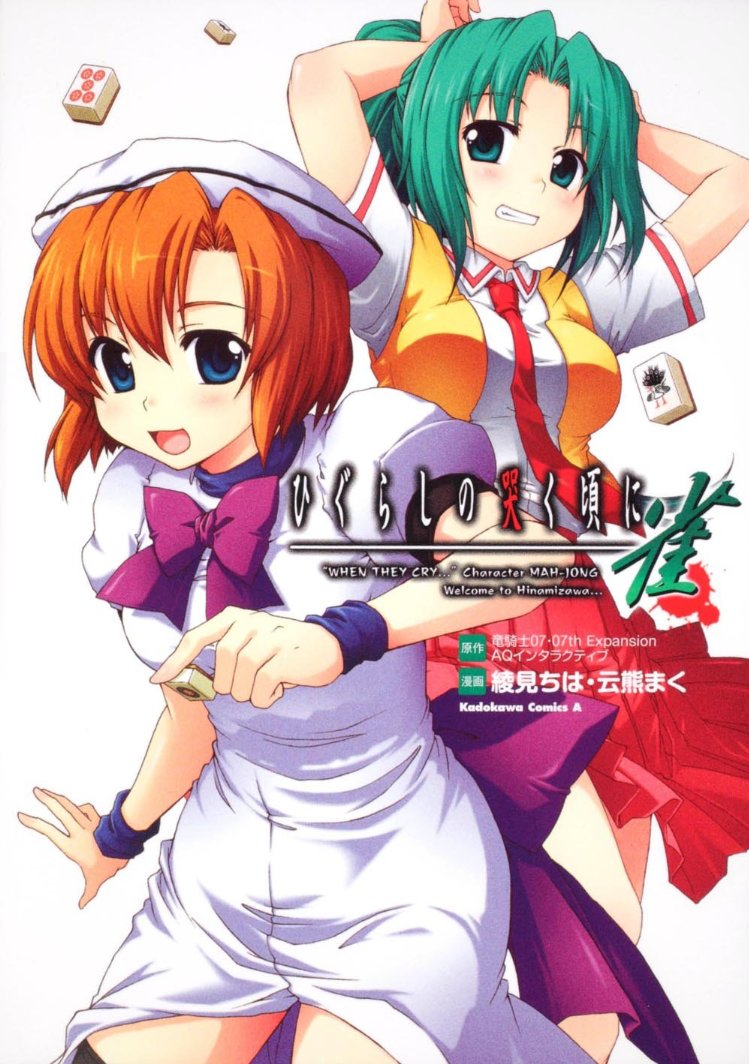
A manga series with the same name was released in 2009. It is an adaptation of the Bukatsu Mode Extra story from the PSP game, featuring The Club playing mahjong as an after school club activity. Later, in 2010, another version of Higurashi no Naku Koro ni Jan was released, Tsubamegaeshi-hen, which seems to be partially based on the Oyashiro Mode, but instead contains a particularly bad end.


Trivia
- In the title screen, the subtitle says "WHEN THEY CRY..." Character MAH-JONG. Welcome to Hinamizawa... instead of the usual subtitle.
- The "Na" in Higurashi no Naku Koro ni Jan utilizes a different character, "哭" instead of the usual "な", though their meanings are the same.
- This kanji was a stylistic choice due to it slightly resembling a table with two mahjong tiles on top of it.
- This game's UI during Mahjong matches shares a very strong resemblance as that of Chuu kana janshitenhoo Painyan Remix (ちゅ〜かな雀士てんほー牌娘 Remix).
- Takano Miyo refers to herself as "Nurse Angel" in her exclusive Ippatsu Riichi cutscene.
- There are three game over speeches that Keiichi gives to the player to continue making them play.
- Depending on who the player selects as the first opponent in Oyashiro Mode, the beginning of the story plays out a bit differently, and the order of the first four opponents are different.
- For example, if the first opponent picked is Rena, then Keiichi suddenly encounters her on his way towards the tournament. But if the first opponent picked is Mion, then Keiichi decides to go to the Sonozaki residence to confront her about the "prank".
- Chie is the only character who does not have the Hinamizawa Syndrome, syndrome sprites, or syndrome voice lines. In Oyashiro Mode, Keiichi cures Chie by feeding her curry instead of giving her the medicine.
- Takano Miyo refers to herself as "Nurse Angel" in her exclusive Ippatsu Riichi cutscene.
- There are three game over speeches that Keiichi gives to the player to continue making them play.
- This is most likely a reference to Keiichi being referred as "a man of words", who can pursue anyone with his speeches.
- There are some differences between the Arcade version and the PSP version.
- The arcade version only has Oyashiro Mode and Bukatsu Mode.
- The top menu in the arcade version does not contain a Keiichi and Rena sprite talking to each other or to the player. Instead, it just shows an icon of a random character with non-voiced acted line of text appearing.
- There are often time limits present in selection screens, such as when selecting the first opponent, picking a cheat card, or deciding what mode should be played.
Gallery


Links
Official website: https://www.marv.jp/products/higurashi_jan/index.html
{{Template:Games}} pt-br:Higurashi no Naku Koro ni Jan